Is a chip conveyor a must for CNC machine tools?
In CNC machining, chip conveyors are not universal, but they become indispensable auxiliary equipment when chip accumulation, reduced precision, or restricted efficiency occurs. The role of chip conveyors is irreplaceable in the following scenarios, as they directly affect machining quality, equipment service life, and production efficiency. Many workshops ask: Is a chip conveyor essential, or just an optional accessory? The answer depends on your machining conditions, production volume, and material type. This article breaks it down from a practical and technical perspective.
What Is a Chip Conveyor?
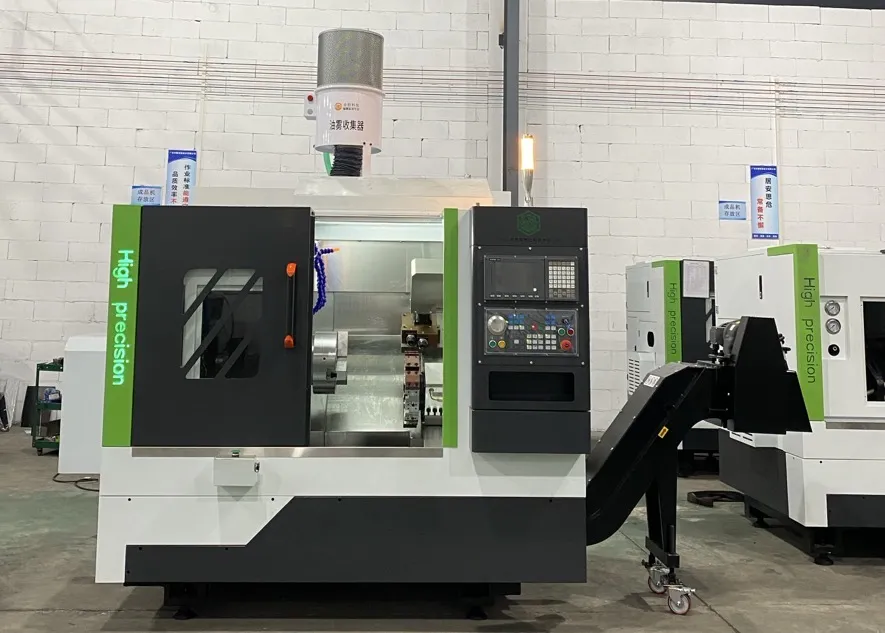
A chip conveyor is a mechanical system installed in CNC machines to automatically remove metal chips from the cutting area. Common types include:
Hinge belt chip conveyor (for large, curled chips)
Scraper conveyor (for fine chips and sludge)
Screw (auger) conveyor (for compact spaces)
Its primary function is to maintain a clean machining environment and ensure continuous operation.
Advantages of Chip Conveyor
Essential for Metal Cutting with Chip Accumulation
When CNC machines process steel, cast iron, aluminum alloy, and other metals, they produce various chips such as curly and blocky chips. If not removed promptly, these chips will wrap around cutting tools and scratch workpieces.
Chip conveyors are required for all metal cutting applications, whether on CNC lathes, milling machines, or machining centers.
Especially in roughing, heavy cutting, and other high-volume chip scenarios, chip conveyors reduce downtime for cleaning and improve machining continuity.
Protects Precision in High-Precision Machining
High-precision machining (e.g., precision molds, aerospace components) has strict requirements for tolerances and surface roughness. Residual chips can cause thermal deformation, surface scratches, and wear to core machine components.
In grinding applications, screw chip conveyors can remove mixtures of grinding swarf and coolant, ensuring precision while enabling coolant recycling.
Enables Unmanned Operation in Automated & Mass Production
Chip conveyors serve as a key link in automated production lines and unmanned machining.
During mass production, they operate synchronously with machine tools to automatically collect and transport chips, eliminating the inefficiency and safety risks of manual cleaning, reducing downtime caused by poor chip removal, and ensuring stable production line operation.
Solves Specialized Chip Removal Challenges for Specific Processes
*Deep hole drilling and tapping are prone to internal chip blockage, requiring screw or tubular chip conveyors.
*Machining difficult-to-cut materials demands chain-plate chip conveyors for chip breaking.
*In wet machining, chip conveyors separate chips from cutting fluid.
*In large-scale equipment machining, chip conveyors with strong long-distance conveying capabilities ensure timely chip removal.
Ensures Stable Operation in Harsh Environments
In harsh conditions such as heavy dust, high oil contamination, and high temperatures, chip conveyors remove chips and impurities, preventing wear on machine bearings, guide rails, and other components, extending equipment life, and lowering maintenance costs.
Core Functions of Chip Conveyors
The core functions of chip conveyors are waste removal, machine protection, efficiency improvement, and precision assurance.Any machining process that generates chips and demands precision, efficiency, or automation should be equipped with a suitable chip conveyor to safeguard CNC machining.
When a Chip Conveyor May Not Be Necessary
1. Low-Volume or Job Shop Work
Small batch production
Frequent machine stops
Manual chip removal may be sufficient.
2. Materials Producing Fine Powder Chips
Such as:
Cast iron
Some composites
A simple chip tray or scraper system may be enough.
3. Space or Budget Constraints
Small CNC lathes or desktop machines
Cost-sensitive operations
Conveyor can be optional if chip load is manageable.
How to Choose the Right Chip Conveyor
Consider:
Chip type (long, short, powder)
Material (steel, aluminum, cast iron)
Machine type (lathe, machining center)
Coolant usage
Available space
Final Verdict
A chip conveyor is not always mandatory, but in most modern CNC environments—especially those focused on efficiency, automation, and scalability—it is strongly recommended and often indispensable.


Comments
Post a Comment